Pages

Sunday, 28 June 2015

Lights and sound...

Hi all,
Time for some updates on activities in the studio.  After returning from the Australian Narrow Gauge Convention a few months back, I normally suffer from two thoughts...burn out from all the lead up to that event and the intense nature of the focused weekend, and then inspiration from who I've spent time talking too and bouncing ideas with.  So after a bit of a rest, and time to gather some thoughts, I ventured out to the studio to get work happening again.  I guess having a NMRA meeting on the calendar was also incentive to move along with a few sections of the build to have something semi presentable for my guests.


Construction projects in the last month or so have mainly involved getting some of the false roof and back drop mounted.  The false roof follows the some principle of the "boxed diorama" style of display I have used for all of my previous layouts.  Using an overhead lighting valance and lower fascia to create a viewing window into the scenes around the layout, therefore restricting the view to just the modelling.  Dedicated lighting for the layout mounted into the false roof provides a solid source of light for optimal viewing conditions.  The false roof was framed with light weight pine frames (mostly recycled from my old Triple Creek layout that was demolished from inside the house) and 3mm MDF panels.  The back scene panels are also 3mm MDF curved and glued to the plasterboard walls.  The blue chosen is the darkest shade of blue I wanted to use in the sky, and will be given a gradual fade down to the horizon using my airbrush. 


As far as the lighting for the actual layout, I have chosen to go with LED globes.  Previously I've used fluoro tubes, which I have been happy with as far as light output, but the hum of the tubes eventually gets annoying to my ears.  The battens for the fluoro lights can also be a bit heavy.  I have looked to light this layout with future supplies in mind.  I was going to use compact fluoro globes, which have good light output as well, but I'm as the use of LED becomes more wide spread, that these type of globes may become harder to match as replacements in the future.  I had experimented with LED strips, but am yet to be convinced with the amount of light they provide.  I have previously built a test strip with up to 4 rows of the LED strips, and they still didn't match to output I expect, to LED globes are the choice I have made based on LED lifespan and the good light these globes provide.  I have had to custom make the recessed fittings for these lights to work.  Firstly, limited space between the false roof and the real life mean these lights can't sit too high above the layout.  The second reason being that I didn't want the recessed down lights to create a spot light effect.  The custom fittings are fabricated with 75mm PVC water pipe, with the ends cut at 22 degrees angle so the globes throw good light at the foreground and background.  The depth of the recessed fitting is also so the globe head sits just below the false roof line to allow this good light spread.  The first overhead valance section was also installed, with the height set at about my eyebrow level.  At this height, it shields most of the light sources from my eye line when standing and operating.  I made a couple of simple jigs for cutting the light openings in the roof with a Dremel router, and one to set consistent valance levels.

 
I have also brought a couple of the scenery sections recycled from Gavin's old North Coast layout into the studio as well (with the large curved trestle bridge section needing some assistance from the demolition saw across the back side of it so it would fit through the door!).  The trestle bridge has been carefully disassembled as it needs to be levelled and run a different curve across the valley.  The other waterfall section is sitting in its rough location, awaiting construction of a new trestle bridge at the entry to the "Brooks" yard.


The end of the line, "Brooks" is the only section with track currently laid, and now powered after wiring in the DCC panel just prior to the NMRA meeting.  A bus wire has been temporarily run around from the central DCC heart to this end section, and the NCE wireless antenna (mounted from the roof above this Brooks yard, which is fairly central to the room) is wired in and tested.  The DCC heart of the layout is powered by a NCE SB3, with 3 DCC Specialties PowerShield X circuit protectors.  In the image below right, the view is of the wireless antenna mounted and hidden from view above the Brooks roof.  The NCE throttle is just plugged into the SB3 for testing purposes.  The night before the NMRA meeting was the first time I'd had the DCC system powered up in the studio for testing, and the first results were fine. The wireless system responded well from all corners of the room, and the one of my Haskell Puffing Billy Na's which has a decoder installed was able to take its first run in the Brooks yard.  Sound was good and performance reliable with the added Stay Alive capacitor on the loco.  It was rewarding to actually see some sound and movement along the rails again.  Always good for the enthusiasm to get this action happening.

 
The room had a bit of a tidy up prior to the NMRA meeting as well.  The bookshelf has been installed to hold my small reference library of railway books.  There is also a "projects storage unit" been built.  This is a storage rack with removable project work boards that pull out and get brought over to the work surface.  The hope is that this will keep projects contained to these boards, and in turn help keep my work benches a bit tidier in the long run.  I can also pick up all the project parts and carry inside to work in front of the TV if I want to.  The storage cupboards are also better organised than previous, such as now all scenery supplies are better arranged.  Other cupboards hold locos and rolling stock, or electrical supplies.


For the time being, the southern wall (where "Upper Gully" will eventually be built) will not have bench work built along it (the storage cupboards are along this wall).  Currently that wall will be used as a work zone for building my joint project "Cwm Machno Quarry" with Geoff.  That layout is about to resume work as it is a goal have the slate layout ready for the 2017 Australian Narrow Gauge Convention here in Geelong.  Cwm Machno has been dusted off and power run around to the work area, so I'll be back into carving and shaping slate rock faces again shortly.


While I had the blue paint out doing the base colour for Upper Gully & Brooks, Cwn Machno also got a quick base colour applied, although it is likely to have a fairly pale and hazy Welsh sky line painted over it.  I have also temporarily brought my Splitters Gorge diorama into the studio for storage.  It will eventually be disassembled and rebuilt as a deep valley (that sits above the book library), so as you enter the room, the right side of the isle will be dominated by the towering Mountain Ash trees, which will also help to view block the towns of Brooks and Upper Gully from each other.  I already have some rough ideas for what to do in the display box that Splitters Gorge is in after it gets rebuilt into the layout...maybe a personal little O-14 project?
 
 
I have an exhibition coming up in July up in Stawell, and will be up there with a display of my gum trees and a few dioramas.  Splitters Gorge will be up there it what will likely be one of its last shows before pulling it apart.  If any of you want to head up to the Grampians in a couple of weeks for the exhibition, please stop by and say hello.  Despite being a bit cold, its normally a pretty god exhibition, with a good range of traders and plenty of layouts on display. 
 
Cheers,
Dan

Friday, 10 April 2015

The 12th Australian Narrow Gauge Convention

Done and dusted.  Another Easter weekend of narrow gauge convention activities completed, and thoroughly enjoyed.  I made the long drive up to Bowral (about and hour or so South of Sydney) this last Easter long weekend, for the 12th edition of the Australian Narrow Gauge Convention.  Always an event I'm keen to get to and make the most of, catching up with other narrow gauge modellers and talking about this enjoyable and sometimes quirky hobby.
 
I got to see many faces that I haven't seen for about two years (since the previous ANGC in Melbourne in 2013), so always good to see how peoples projects have progressed.  There were a good range of clinic topics on offer, from casting techniques, weathering, diorama design, DCC tips, layout sound, working with brass etc, plus various presentations on prototype settings.  I was up there also to present my clinic on how I model my gum trees.
 
The modelling contest was well represented as well (as usual).  Perhaps a lower number of entries than I though would have been submitted, but quality was all there.  Each effort looked to be the modellers best efforts, and the standard was much appreciated by the viewers.  It was a tiring weekend, but also very rewarding.  I always find a NGC good for the spark to get the modelling enthusiasm going.  I've been busy on 1:1 work projects around home, so modelling time has been quite limited lately, and spending the intense time at the NGC gets the ideas well and truly going again.  I'm certainly keen to get back into some more creative adventures again.  Time to let the pictures tell the rest of the story...


At the conclusion of this most recent event, I was also able to finally announce that the hosting town for the 13th Australian Narrow Gauge Convention, to be held at Easter 2017, will be my home town, Geelong.  Planning is already well under way for this next ANGC, with a venue locked in, and discussions already had with The Bellarine Railway, to incorporate some preserved steam into this future event.  Websites and details will be released in the near future, but some interesting displays and topics are already being discussed, so something to lock in and start planning your holidays around!
 
 
Cheers,
Dan


Thursday, 19 February 2015

Moving in...

Hi all,
While battling the "man flu", thought it would be a good time to update the old blog a bit.  Been busy with considerable progress since the last update.  The studio got some internal stud walls, insulation, wired up and then plastered.  Since its a dedicated modelling and layout space, it meant I had total control over what it looks like in the end (ie its not a room in the house that I have to consider keeping it semi house looking).  As a totally independent structure, I have creative freedom, so out came the black paint.  Once the layout goes in, I wanted it so there weren't too many distractions from the modelled scenes, so blacking everything out that isn't actually layout forces you to view only the important parts (a bit like when you go to a museum and only the displays are lit). 
 
 
Firstly, all of these progress pics are just quick phone snaps, so excuse the low quality.  Life is getting quite civilised in the studio, with the carpeted floor, plastered walls and LED down lights.  These LED ceiling lights are low wattage warm white, designed to provide reasonably dim (but sufficient) light for moving around what will be the isles in the room.  There will be brighter lighting built into the layouts overhead lighting valance at a later stage.  The black roof does a fairly good job of disguising the low ceiling height of the studio, but at the end of the build, not much of the ceiling will actually be visible once the layout roof lines are in place.  Not photographed, but a 45mmx70mm timber batten has been mounted right around the walls (much like a dado rail) at 1050mm high to serve as an anchor point and level for the layout frame that will attach above it.  Rail height will be approx. 1200mm which allows for cut-away's below track level for things like creeks and hollows in the terrain.  Underneath the layout is where a heap of storage cupboards and my various workbenches are being assembled.
 
 
I know, that quickly went from being a vacant and spacious room to the image above.  I guess since I've being picturing this studio space in my head for so long before being able to get around to building it, I've had plenty of time to think about all the ways I wanted to design it, so when it has now become reality, getting this bench work in place has been a quick process...I didn't have to sit down and think about what I wanted in this room after it was built because I've known in my mind for quite some time how it all needs to happen. 


A friend of mine had been renovating their house, so I was able to rescue and recycle a lot of their old kitchen bench tops and cupboard units...all great for my needs.  I have about 5m of workbench length now under the layout, so can have a few different dedicated work areas.  One area is set up for loco and rolling stock work, the others more for structures and scenery jobs, with relevant materials stored near the associated work area.  I was also able to get some granite bench tops from the recycling (seen here under the peninsula area, which will have a sawmill modelled above it). The effort to carry and install this rather heavy material has resulted in a good hard and flat surface for working on.  Under layout lighting makes the work zone good and bright for working in.  Later when the layout is nearing completion, black curtains will cover these work spaces when running an operating session.  The work benches are low at just 600mm from the ground, but is a comfortable working height still as I have a lowered seat for use (not the stool seen in these pics).  Ideally I would have liked to have them a bit higher, but the layout would also have to have been higher, and the restricted roof height of the studio would have not left enough height to model my gum trees in effectively.  It was preferred to have the layout how I wanted it and compromise to work zones to suit.  It looks a bit low and cramped, but ergonomically when siting there it is perfectly fine for me.


I needed to establish these work and storage zones first up so I could demolish my old far from finished "Triple Creek" layout, that was  briefly mentioned way back on my first post to this blog.  Rather than pack all that stuff up for the move 20 feet out the back door, this new work space was prepared and then everything just picked up and carried out to its new home.  A lot of the old layout bench framing will be recycled in the construction of the overhead layout roofing and lighting valance.  Who knows, I might even get back into doing some modelling in the near future!
 
Cheers,
Dan
 

Wednesday, 29 October 2014

Birth of a new studio...

It finally happened.  After a number of delays and thoughts about the appropriate time to actually build this new project, there is now something solid in the backyard.  I had intended to start building this new shed/studio space nearly 18 months ago, but a few different home chores kept taking higher priority.  As it was, I probably had intentions to still delay this new shed until after the 2015 Australian Narrow Gauge Convention, but it pretty much came to the fact I've nearly run out of storage space around home.  With two different layouts under construction out in the garage, as well as a heap of salvaged cabinets from a friends recent home renovation (enough to use for all the under layout storage I will have in the new space), I needed to establish the new studio/shed to free up space around the house.  The last posting showed the old garden shed being demolished.  The new shed is now up...twice the size, and all dedicated studio modelling space.


 Stumps dug, bearers installed, shed goes up (knew the kids would come in handy one day!), and the flooring is starting to go in.  Moving large sheets of yellow tongue solo is a "fun" job.  The final space will end up being roughly 3.5m x 5m once the inside of the shed gets a light stud wall and some insulation installed.  The roof line ended up being slightly lower than originally intended, but turns out it will help make the room feel bigger.  I had planned to leave it open over the layout, but with the lower roof, will go back to including an overhead lighting valance around the layout footprint (much the same as my previous exhibition layout designs).  This will essentially create a couple of corridors around the layout space.  With a blackened roof and all the under layout storage covered by curtains, it will make it harder to view the whole layout from one spot, meaning you'll have to walk around the scenes to experience it.  The size of the trees that will be across the layout will also create plenty of view blocks. 
 
Still a lot of work to be done before anything like a modelled layout starts to take shape (lining the walls, running power and lighting, reconfigure the cabinet work etc etc), but it is nice to now know there is some definite progress in the backyard, rather than just talk of this future home layout dream.
 
Cheers,
Dan

Monday, 22 September 2014

Blank canvas...

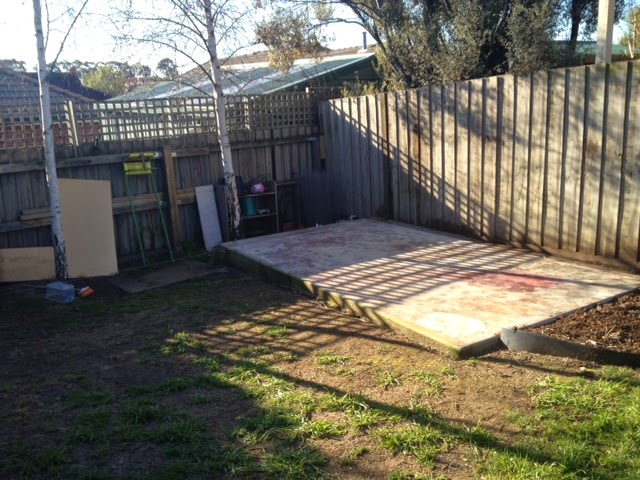
Just started some holidays, and with a bit of sun in the sky again, time to create a blank canvas.  Have finally made a start of what will be the future modelling studio space in the back yard.  First step was to demolish the previous garden shed that stood in the corner of the yard.  Hardest part was removing the multiple layers of silicon that I'd built up around the base to try and keep the water out, followed by dodging all the falling spiders.  An afternoons work had the old shed removed...which apparently leaves the perfect stage (the concrete slab) for a couple of young dancing girls to put on an impromptu show during my coffee break :)


With the next few weeks off work, will hopefully be able to make some reasonable progress with getting the ground work done with the new construction.  If only I can get the kids excited about digging me a few deep holes to drop the stumps into!
 
Cheers,
Dan